
Three things people call a holding structure
A holding company primarily owns shares in other companies. Here, a Norwegian holding company is an AS. First identify which structure is being proposed: its purpose and consequences determine whether it is useful.
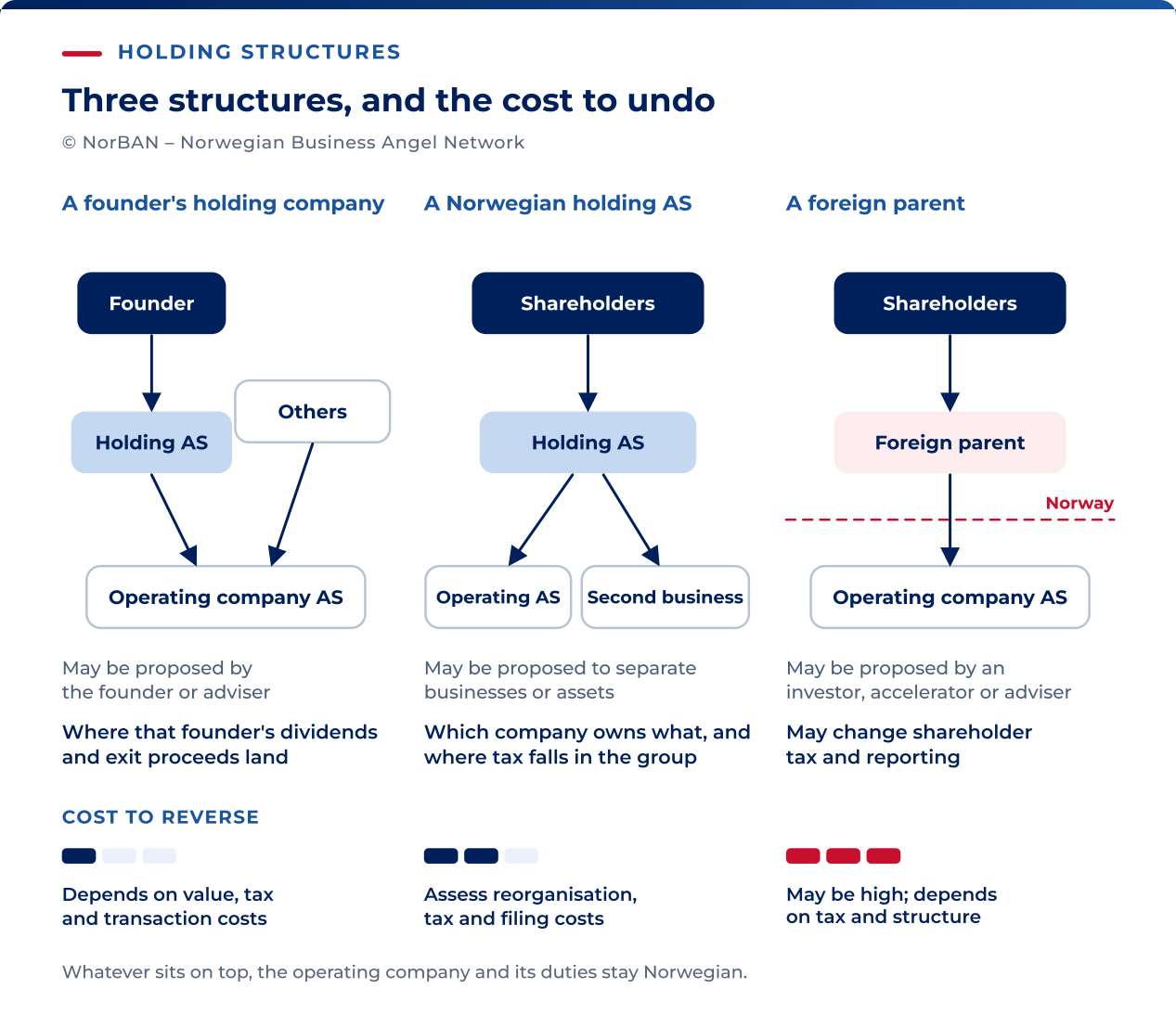
| Structure | Who commonly proposes it | What changes | Reversing it |
|---|---|---|---|
| Founder’s own holding company | The founder or adviser | Who receives dividends and sale proceeds; how transfer restrictions apply | May trigger tax and require corporate steps. Low share value can reduce the tax exposure, but does not remove the need to assess it |
| Norwegian parent above the operating company | The board, for example to separate businesses or assets | Which company owns each business or asset; group tax positions | Requires a new assessment and potentially another reorganisation and filings |
| Foreign parent above the Norwegian company | An investor, accelerator or adviser | Shareholder tax positions, governance and cross-border reporting | May require another cross-border reorganisation. Consequences differ between shareholders |
For a founder’s own holding company and the related shareholders’ agreement provisions, see investor-friendly structure. Here the question is whether to put a Norwegian or foreign parent above the operating company.
When the question is real
Check whether a parent would meet a specific need. There should be a practical reason to proceed:
- Separating another business or an asset from operating risk.
- A documented investor requirement.
- A concrete international expansion plan. Check whether a local subsidiary alone would meet the need.
- An arrangement between co-founders that calls for separate ownership companies.
Do not commit before the purpose, costs and alternatives are clear. A future market entry can justify planning now; it does not automatically justify a foreign parent.
The questions to send back
An investor may ask for a flip in conversation before it appears in a Norwegian term sheet. Establish whether it is a condition of investment or a preference, before repeated discussions turn it into an assumed commitment.
Tailor your questions to the person proposing the structure. Ask for the evidence that supports their request:
- An investor citing the fund’s rules. Ask for the relevant provision and whether it is mandatory or the investor’s preference.
- An accelerator with a standard agreement. Ask which programme benefits depend on the structure and whether you can participate without it.
- An adviser proposing the structure. Request a written scope, fee, timetable and tax assessment for each shareholder. Agree what happens if a shareholder declines.
- A co-founder suggesting a structure. Identify the concrete current or planned need and compare simpler alternatives.
Agree who pays and whether the reorganisation remains necessary if the investment falls through. Reorganising before an investor commits can leave the company or founders with costs and risks without the expected funding.
The timing arithmetic
The cost depends on the structure, required consents, professional work and potential tax. As share values rise, a taxable transfer can produce a larger gain. Timing therefore matters, but value is not the only cost driver.
Contributing personally held shares to your own holding company normally constitutes a taxable realisation. There is no general rollover exemption just because you still own the business indirectly. A separate reorganisation may qualify under the merger or demerger rules; assess that before transferring shares (domestic share exchanges).
The absence of a priced round does not establish a low value. A transfer can create a taxable gain without producing cash; establish market value and the available restructuring route before moving the shares.
When both companies are resident in Norway, the exchange falls outside the cross-border share-exchange exemption and is a realisation (Skatte-ABC A-1-2). Whether tax is payable also depends on the shareholder: for example, a qualifying corporate shareholder may fall within the exemption method.
A qualifying merger, sometimes combined with a demerger, may provide tax continuity when establishing a Norwegian holding structure. A triangular merger is one possible component: shareholders receive shares in the acquiring company’s parent. There is no universal requirement to carry out a demerger first. Choose the sequence for the existing ownership and business structure (Companies Act chapters 13 and 14).
A tax-free merger or demerger requires tax continuity at company and shareholder level. Values must be allocated correctly. In a demerger, nominal and paid-in share capital must be allocated in the same proportions as net values under section 11-8. See also section 11-7 on continuity and Skatteetaten’s ruling on a drop-down demerger.
An incorrect exchange ratio can make the reorganisation taxable. Establish the valuation before drafting the exchange terms.
The exemption method can make a holding company useful for reinvestment. Qualifying share gains are generally exempt, with no deduction for corresponding losses. Normally 3% of qualifying dividends is taxable, equivalent to 0.66% at a 22% tax rate; an exception applies to qualifying intra-group dividends. Personal dividend taxation is a separate matter when funds are distributed to an individual shareholder (section 2-38).
The foreign parent: what is actually being asked
The structure is straightforward to describe. A new company is formed abroad, the shareholders exchange their shares in the AS for shares in it, and the AS becomes an operating subsidiary.
A cross-border share exchange (aksjebytte) can qualify for tax-free treatment for shareholders. At least ninety per cent of the shares in the Norwegian company must be transferred in exchange for shares in a limited-liability company resident in another state (skatteloven § 11-11 fourth paragraph).
The acquiring company may be resident inside or outside the EEA.
A qualifying exchange carries tax positions over to the new shares; it does not erase the underlying gain. If the exchange does not qualify, ordinary realisation rules apply. The shareholder’s other exemptions and tax position still matter.
- Ninety per cent. At least ninety per cent of the shares in the Norwegian transferring company must be transferred.
- The twenty-per-cent limit. Shares in a company directly participating in the exchange must make up most of the payment. Everything else may total no more than a fifth of the payment, including shares in companies outside the exchange. Any additional consideration (tilleggsvederlag) is taxed in the ordinary way.
- Continuity at shareholder level. For shareholders taxable to Norway, the new shares must carry over the input value, acquisition date, shielding basis and unused shielding allowance of the old shares. The acquiring company’s state does not need to require continuity or even have continuity rules.
Skatteloven § 11-11 fourth paragraph also applies §§ 11-6 and 11-10: consideration other than shares is taxable, gift elements are outside the relief, and the effective date matters. Confirm continuity of each shareholder’s tax positions under § 11-7 and that both companies exist before the exchange.
These are key checks, not an exhaustive clearance; use the Skatte-ABC guidance and advice on the transaction.
The low-tax exclusion differs inside and outside the EEA (skatteloven § 11-11 seventh paragraph, Skatte-ABC A-1-3.3):
- A participating company resident in a low-tax country outside the EEA excludes the exemption.
- In a low-tax EEA country, the company must be genuinely established and carry on genuine economic activity there.
The drafting must also account for how the exchange is carried out. The exchange may be effected by issuing new shares or by writing up existing ones, both companies must have been incorporated before the exchange, and preceding dividend distributions treated as independent equity transactions are left out of the twenty-per-cent computation (Skatte-ABC A-1-3.2).
A flip can become contentious because each shareholder faces their own tax consequences, which can be substantial. Model the position for every holder before anyone signs.
Obligations to resolve before restructuring
Assign someone to resolve each of these matters before taking the corporate steps. Several require agreement from people outside the company:
- Employee options. Check whether the options will continue to qualify under the start-up scheme, as discussed below.
- Convertibles and outstanding SLIPs. Read the reorganisation, conversion and consent clauses. A change is not always required, but any necessary amendment or settlement should be agreed before the exchange.
- SkatteFUNN. Approval belongs to the applicant organisation number and cannot be transferred. Financial-difficulty tests concern both the applicant and the relevant economic group at approval.
- Research Council grants. Under the 2025 general terms, non-EEA control of the project owner or a partner must be reported promptly. During the project and for three years afterwards, transferring project-result ownership or an exclusive licence to a non-partner outside the EEA requires written approval. The terms provide a four-week response mechanism. Check the actual grant contract and any change of project owner.
- Ownership records and reporting. Update the shareholder book, shareholder reporting and beneficial-owner registration as required by the transaction and their respective deadlines.
- Other shareholders. Identify the approvals and individual agreements needed. Explain each owner’s tax consequences and available choices.
For options under the start-up scheme, identify who remains the employer and which company’s shares the option gives a right to acquire. The scheme requires shares in the employer company. Its conditions have different testing dates: some apply at grant, while others also apply during the option period (FSFIN section 5-14-12).
A change in group structure does not by itself count as exercise of an option (Skatte-ABC F-7-3.4), which answers a different question from whether the scheme’s own conditions survive.
Replacing an option over employer-company shares with an option over a new parent’s shares does not automatically satisfy the employer-share requirement. Retaining the original option is a different arrangement: check the continuing employment, option and group conditions rather than assuming either treatment is safe in every reorganisation.
If a replacement is a new grant, reassess the exercise price and the statutory exercise window of three to ten years from grant, alongside the other scheme conditions. Obtain transaction-specific tax advice before changing the awards.
A binding advance ruling may clarify the tax treatment of a sufficiently concrete planned transaction. Apply before carrying out the transaction on which a ruling is needed; forming the parent and changing the options are not necessarily the same step.
Moving the parent later
Distinguish a cross-border merger from a conversion, where the company changes its legal form and jurisdiction while continuing as the same legal entity. Norway already has statutory merger procedures; conversion procedures were still being considered on 9 October 2026.
A cross-border merger exists. It needs at least one Norwegian AS, ASA or SE and at least one company of equivalent form registered in another EEA state, and Brønnøysundregistrene runs it as a four-step process under allmennaksjeloven chapter 13.
- File and publish the merger plan.
- Approve the merger no earlier than one month after publication of the plan. File the decision within one month after the last participating company has approved it.
- Request confirmation that the conditions are met, no earlier than six weeks after publication of the merger decision.
- Complete and register the merger in accordance with the applicable procedure.
For cross-border conversions, the government consultation of 30 June 2026 proposed new statutory procedures. As checked on 9 October 2026, the proposal was still under consideration; it should not be described as enacted law.
EEA freedom of establishment is also relevant. The absence of a domestic statutory procedure is not the same as the absence of all rights under EEA law. Whether a particular conversion can be carried out, and how, requires assessment of both countries’ rules and the applicable EEA requirements.
The procedure is being introduced through the EEA implementation of Directive (EU) 2019/2121. The Nærings- og fiskeridepartementet consultation on amendments to aksjeloven and allmennaksjeloven was issued on 30 June 2026 with a deadline of 30 September 2026.
A newly formed foreign parent followed by a share exchange is one possible route. A qualifying cross-border merger is another type of transaction. Compare the corporate and tax consequences rather than treating either route as automatic.
A shareholder whose own liability to Norway ends carries their position with them. Under skatteloven § 10-70, a personal taxpayer moving abroad is taxed as if shares and certain other assets had been realised on the last day before Norwegian tax residence ends under internal law, or before a treaty treats them as resident elsewhere.
Section 10-70 also covers certain transfers abroad, but its interaction with any qualifying tax-free reorganisation must be checked. Under the current rules, emigration has a NOK 3 million deduction from net gains. A transfer abroad has a NOK 100,000 threshold: if exceeded, the whole net gain is taxable. These amounts concern gains, not share values. Special aggregation rules apply if transfers and emigration occur in the same year.
The applicable rules depend on the transaction date; major changes took effect on 20 March and 7 October 2024. Under the current rules, payment can be immediate, in twelve equal annual interest-free instalments, or deferred with interest to the end of the twelve-year period. The period runs from the end of the tax-recognition year, which is determined by the deemed realisation date immediately before the move. Security and reporting conditions apply. Sales, transfers and distributions can accelerate payment; for example, the distribution rule generally requires payment of 70% of a distribution towards the deferred tax, subject to statutory limits (sections 10-70 and 14-25).
Company exit taxation is a separate question under section 10-71. Its deemed-realisation rule concerns moves outside the EEA and moves to low-tax EEA states without genuine establishment and activity. Even where that rule does not apply, assets or liabilities leaving Norway’s taxing jurisdiction may fall under section 9-14. Do not apply the individual shareholder’s thresholds or payment rules to the company.
What stays Norwegian whatever sits on top
If the operating AS remains the same legal entity under a new parent, it remains subject to Norwegian corporate duties and retains its contracts. Update ownership records and reporting. Also check change-of-control clauses: keeping the same organisation number does not prevent a contract from requiring notice or consent.
Under domestic law, a company incorporated under Norwegian company law is resident in Norway. A foreign-incorporated company is resident here if its real management is in Norway. Both rules are subject to section 2-2(8): a tax treaty may determine that the company is resident in another state (section 2-2).
Assess where board-level and day-to-day management actually take place, together with other relevant organisational and business circumstances. The registered address and formal minutes do not by themselves settle the question. Delegating management requires examining who actually exercises it.
Document the management arrangements and any claim to treaty residence abroad. A foreign registration certificate alone does not establish the treaty outcome.
Start with the recipient’s award letter and attached terms, then check any group-level requirements. A new parent can affect control, enterprise size and state-aid limits even where the recipient keeps its organisation number. Loan, guarantee and grant conditions are not interchangeable.
Repayment or loss of a grant depends on the scheme and award terms. Check requirements on ownership, project purpose, eligible costs, reporting and record retention. Grounds for recovery can include incorrect information, use outside the purpose, excess payments or breaches of state-aid rules; there is no single three-year documentation deadline for all schemes.
For loans covered by Innovation Norway’s guidance on changes to running loans, ownership changes require consent before implementation. Merger, demerger and debtor substitution have their own procedures. The guidance expressly excludes start-up loans, which have separate terms: read the actual loan agreement.
For SkatteFUNN, financial difficulty is assessed at the date the Research Council approves the application. Later financial difficulty or bankruptcy does not itself invalidate that assessment. This does not excuse other eligibility failures or incorrect information at approval (Skatte-ABC F-29-2.2.5).
Check the enterprise-size calculation after an ownership change. Under FSFIN section 16-40-5, partner enterprises normally count proportionately, while linked enterprises count in full. Use the prescribed staff and financial data and aggregation rules; the recipient’s own headcount alone is not sufficient.
Enterprise size affects the maximum combined public support and eligibility for first-time patenting costs. Small and medium-sized enterprises can include qualifying first-time patenting costs under FSFIN section 16-40-6. Check the category and the effect of all other public support for the relevant costs.
Separate a change of ownership from a change of organisation number. With the same recipient, check changed project facts, enterprise size, state-aid limits and applicable notification requirements; do not presume that every ownership change cancels approval. Approval cannot transfer to a new organisation number. The Research Council requires a final report from the old recipient and a new application for the remaining project, submitted by 15 December in the year of the change. It processes the new application after receiving the old project’s final report (project changes). Ask for a specific clarification only where the actual transaction leaves a requirement unresolved.
If the decision is yes
- Engage counsel and a tax adviser before anything is signed, and give them the cap table as it stands today.
- Model every shareholder’s position, including the holders who are not in the room.
- Handle option holders and instrument holders explicitly, with a written answer for each of them.
- Use a binding advance ruling (bindende forhåndsuttalelse) where the question is one it can answer. Skatteetaten can decide whether a planned disposition meets a condition as a matter of law, including whether tax continuity applies; it cannot settle a valuation, an evidential question or the size of a discretionary adjustment (Skatteforvaltningshåndboken chapter 6).
- Take the corporate steps in order, and keep them out of the closing week of a round.
Take the proposed structure to counsel and a tax adviser for advice on your circumstances. Model every shareholder’s tax position before anyone signs.