
The thesis in one page
Write your thesis before the first case arrives, and keep it to a page. Record these six choices so you can quickly recognise deals that do not fit.
- Sector. The two or three fields where you can judge a team’s claims and be useful after the money, and the fields you will not touch.
- Stage. Pre-seed, seed (såkorn) or later, which sets the risk, the ticket and the return each position has to be able to defend.
- Geography. Where you can meet the founders, follow the company and still be useful at the next round.
- Ticket range. The first investment and its ceiling, derived below.
- Positions planned. How many companies over how many years.
- Involvement. Passive, sparring partner, or board seat, and how many of each you have time for.
Sector focus and the competence test
Invest where your experience lets you check what the founder says. Sector experience helps you distinguish a strong case from a plausible pitch and contribute to the company after investing.
The data agrees. In the 2007 US study of 1,137 exits, investments connected to the angel’s own industry expertise returned roughly twice as much as the rest. The 2009 UK study found industry-specific expertise significantly related to better exit results.
Most angels in Norway have no sector preference, on NorBAN’s published figures; among those with one, B2B software dominates, and domain specialists cluster in construction and property, energy and climate, ocean and industry, and health.
For a deal outside your field, join a syndicate whose lead has the relevant expertise. Focus your own assessment on the areas you know.
Choosing a stage
Nearly all angels in Norway prefer to invest at pre-seed, few invest later than a seed round, and fewer than a third will consider a Series A. Your entry stage determines the risk, investment size and involvement, as well as the potential return you need to justify investing.
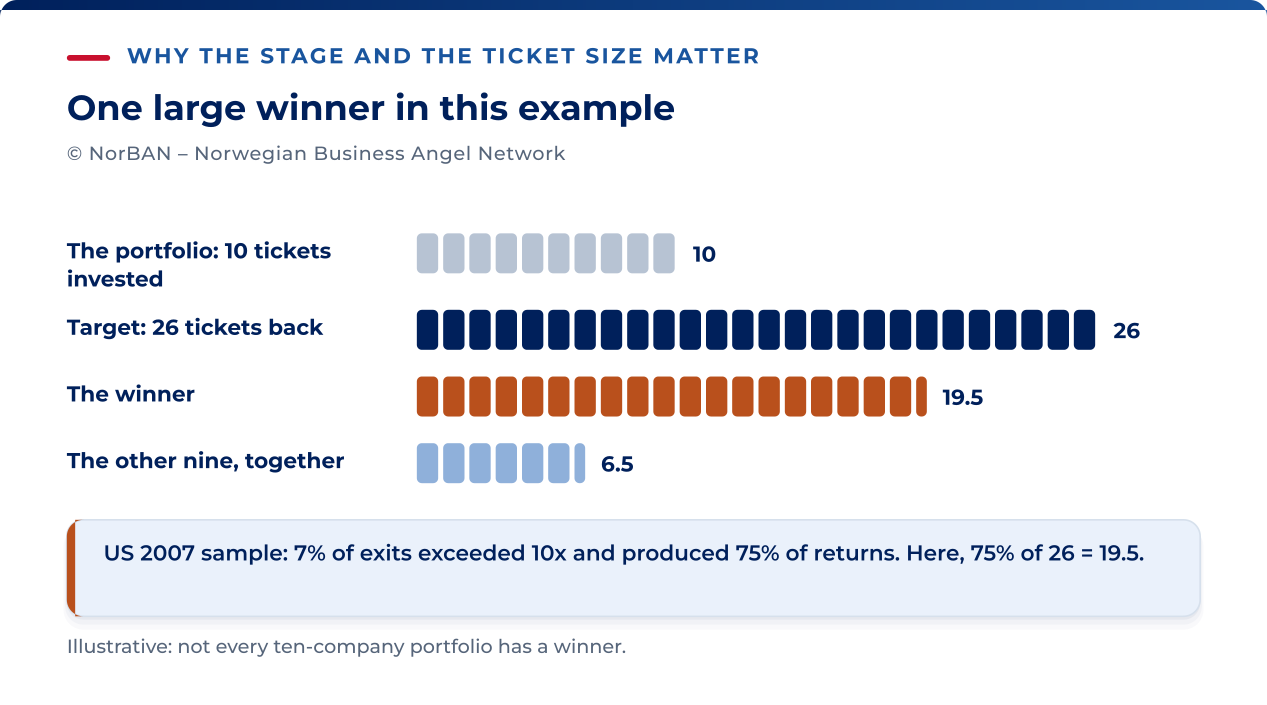
The published returns data helps put that required return in context.
In the 2007 US study, 7 per cent of exits returned more than 10x and produced 75 per cent of all dollar returns; in the 2009 UK study, 9 per cent of exits produced close to 80 per cent of positive cash flows. The portfolios as a whole returned 2.6x and 2.2x.
Consider ten equal investments and a target return of 2.6 times the total invested: 26 times the amount put into one company. If one winner provides 75% of proceeds, it must return 19.5 times that amount, with the other nine returning 6.5 between them.
This illustrates the reported concentration; it does not predict a winner in every ten-company portfolio.
That winner returns 19.5 times its investment after dilution. On the same assumptions, a fourteen-company portfolio needs total proceeds of 36.4 times the amount put into one company, with the winner supplying 27.3.
Seven per cent of fourteen is approximately one; it does not guarantee one exceptional exit.
Test prospective investments against the return your portfolio scenario needs. In the valuation example, two later rounds each dilute existing holders by 20%, leaving 64% of their initial stake. Dividing 19.5x and 27.3x by 0.64 gives undiluted hurdles of about 30.5x and 42.7x. Different rounds, pools and instruments change those results; two rounds do not automatically halve a holding.
A seed entry with one round ahead needs less, and a later entry with a shorter hold and less dilution ahead needs less again. At an earlier stage, more of the value depends on what the company has yet to build. The potential return needs to justify that uncertainty.
Calculate each investment from your portfolio plan
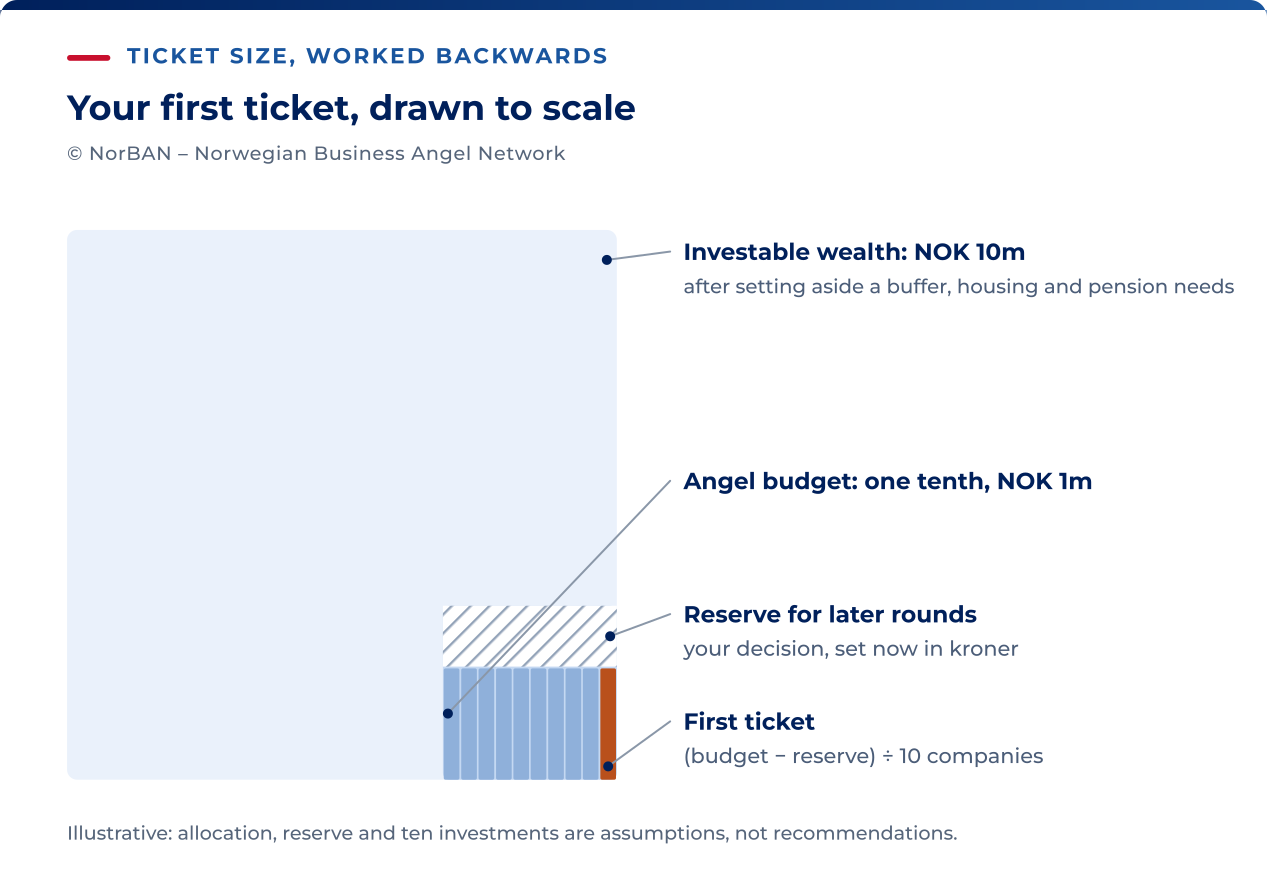
Set your investment size before a founder asks, using your allocation, reserve and planned number of positions. Work through those decisions in order; the example is illustrative.
| Budget line | Example |
|---|---|
| Investable wealth, after the emergency fund, housing and pension | NOK 10 million |
| Share allocated to angel investments | One tenth: NOK 1 million |
| Reserve held back for later rounds in companies that are working | Your decision, set now as a kroner amount |
| Positions planned over the deployment period | Ten |
| First investment | The allocation, less the reserve, divided by ten |
Foreign guidance can help frame your allocation, but the measures and contexts differ:
- An undated practitioner paper published by the Angel Capital Association reports 5 to 15 per cent of net worth as conservative American guidance.
- Seraf suggests 5 to 10 per cent of investable net worth.
- The UK regulator sets a 10 per cent limit for self-certified restricted investors.
Research and practitioner guidance suggest different portfolio sizes. A simulation study of the angel-returns datasets found that portfolios above 50 investments are needed to significantly reduce the risk of a poor outcome; practitioner guidance puts the absolute minimum at 10 and says 20 is better.
What angels hold is less: a mean of 17.1 investments over an investing lifetime in the UK survey of 2020, and an average of 14.2 current positions among experienced angels in the American survey of 2017, as reported in Forbes. Ten is a floor, and the evidence says to plan for more than ten as the capital allows.
With no reserve, the example gives a first investment of NOK 100,000, which is the median round-filler ticket in Norway. Holding a reserve reduces the amount available for each first investment.
Set the reserve now as a specific amount, before the pressure of a follow-on request. The round you are asked to join later is usually the one you already know most about, and a company raising a flat round needs its existing holders.
Use a reserve policy to decide which later rounds merit more capital. Familiarity with the company and a flat round are reasons to investigate, not reasons on their own to invest again. In the cited 2007 and 2009 studies, exits that received follow-on money returned less than those that did not; the follow-on article examines the decision in more detail.
Typical investment amounts in Norway
NorBAN’s published figures describe angel tickets in Norway as three bands. Use them to place your first investment, and to see what a round will expect of you at each size.
| Type of angel | Ticket sizes | What they do in a round |
|---|---|---|
| Micro Angel | 30–500 kNOK | The majority of Norwegian angels. They complete a round others have shaped; often passive, and often operators with a day job. |
| Core Angel | 0.5–2 MNOK | A round needs at least one to lead or anchor it. Can be a sparring partner alongside the ticket; rarely takes a board seat. |
| Super Angel | 2–5 MNOK or more | Professional investors who can carry a round substantially alone. Usually requires regular follow-up and close collaboration. |
Small round-filler tickets have a median of about 100 000 NOK and the larger tickets a median of about 1 million. Roughly one in six angels can anchor or lead a round, and a normal first or second round commonly includes four to six angels. The page calls these rough estimates from a decade of experience and self-reporting.
For scale, EBAN’s compendium for 2024 put the average visible European angel round at about EUR 205,000 per company, and FiBAN publishes a median round of up to EUR 300,000 for startups applying through its network. A Norwegian pre-seed round is assembled from several Micro and Core tickets around one anchor.
Using the thesis on live deal flow
Most of what reaches you will fail the thesis in the first minute, on sector, stage or geography, and that is what the page is for. Decline those the same day, and say which line failed, so the founder and whoever sent the case both learn something.
Tell your referrers what the thesis says. Other angels, the regional group and the founders you have backed all send cases, and the ones who know your sectors and your ticket send fewer wrong ones.
Make exceptions deliberately and keep track of them. A case outside the thesis that you take on the strength of a lead you trust is a legitimate decision; three in a year means the thesis is wrong, so rewrite it. Reread the page once a year, with the portfolio sheet beside it, and change the lines that experience has changed.