
Money you can afford to lose
Angel capital comes last in the order of your finances. The emergency fund, the pension and a diversified core of listed assets and property are in place first, and the angel allocation is carved from what is left over.
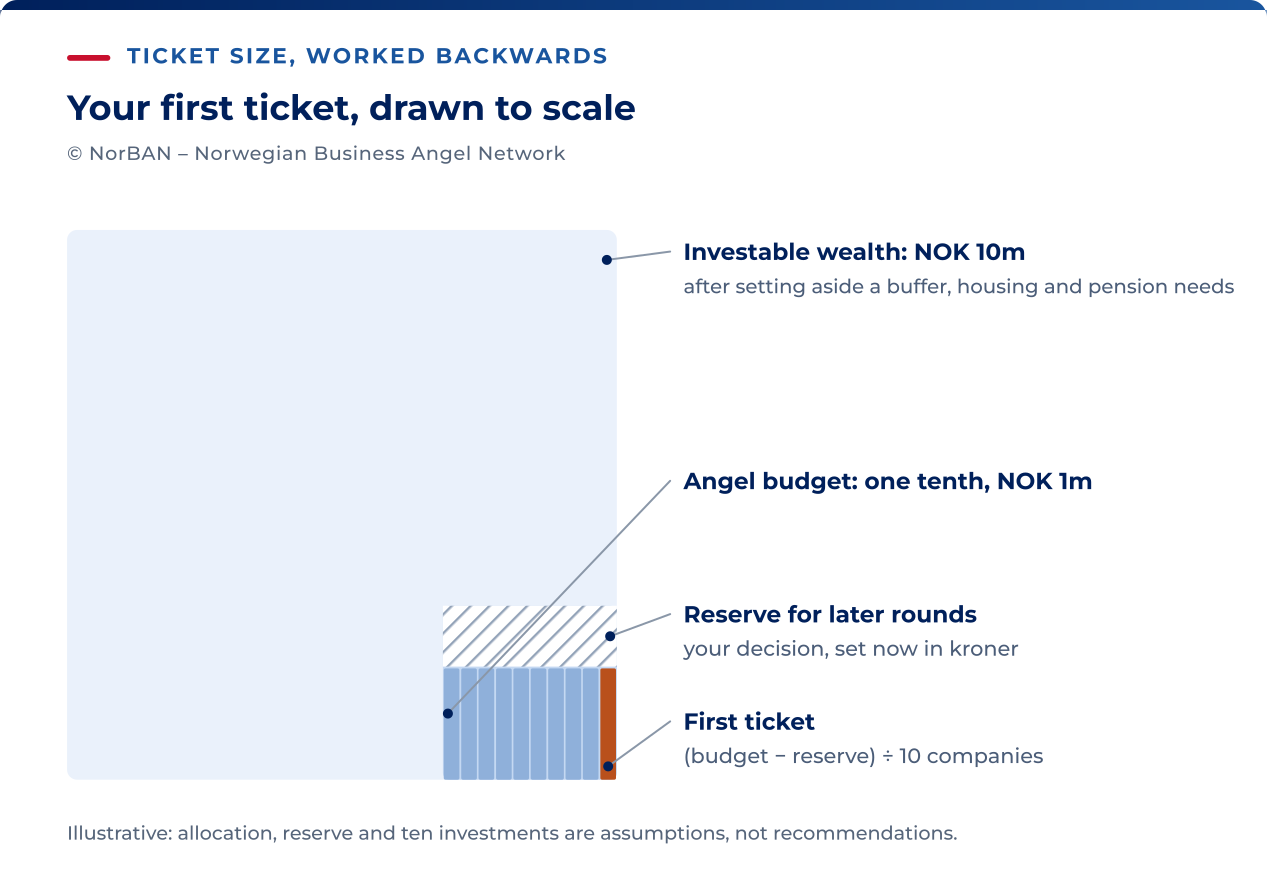
Published guidance from outside Norway offers a starting point for sizing the allocation. An undated practitioner paper published by the Angel Capital Association, on American survey data from 1994 and 2001, reports conservative guidance of 5 to 15 per cent of net worth, and that half the angels surveyed committed no more than 15 per cent.
Seraf, an American practitioner source, says 5 to 10 per cent of investable net worth. The UK regulator requires a self-certified restricted investor to confirm they will put no more than 10 per cent of net assets into high-risk investments. Read these as the shape of a sensible allocation, sized so that a total write-off changes nothing about how you live.
Total loss on a single position is a normal outcome. In the 2007 US study of 1,137 angel exits, 52 per cent returned less than the capital invested; in the 2009 UK study, 56 per cent, most of them a total loss.
For a business angel (forretningsengel), the practical test is whether a position could fall to zero without affecting the rest of your life. If it could not, the allocation is too large, whatever the percentage.
The time each investment takes
Published studies offer a starting point for estimating the time involved. Median due diligence was 20 hours per investment in the 2007 US study and again in the 2009 UK study, where investors who spent at least that had significantly fewer failures.
McKaskill, writing in 2009 and citing a German study, reports angels spending about 1.34 days a month on each portfolio company.
Estimate your own commitment by considering:
- how many positions you intend to take a year, since every one carries its screening, its diligence and then years of follow-up
- how much of the ecosystem you attend, because deal flow arrives through people and events, and both take evenings
- whether angel investing sits beside a full-time position or is the job
Leading a deal multiplies the load. The lead runs the evaluation and the negotiation, engages counsel, keeps the other investors informed and often takes the board seat.
Following an experienced lead reduces the work, although you still decide whether to invest your own money.
A board seat adds the meeting cycle and the annual accounts; an observer seat has no director’s statutory office, but can carry confidentiality and other contractual duties, and liability for contributing to harm.
A decade without liquidity
There is no market in the unlisted shares (unoterte aksjer) of a Norwegian startup. Nobody quotes a price, nobody is obliged to buy, and the company pays no dividend while it reinvests everything it earns.
Plan for a long holding period. Five to seven years is a planning assumption, not a minimum every investment will meet, and some holdings last much longer.
The published US and UK study means of 3.5 and 3.6 years cover investments that exited. They are not deadlines for recovering your own investment; failures and successful exits can have different holding periods.
A sale before exit needs a willing buyer. Unless the articles provide otherwise, company consent is required; the board may refuse only on objective grounds, and consent is deemed given if no refusal is notified within two months of the company receiving notice. Statutory pre-emption and contractual restrictions may also apply.
Neither a sale date nor a price is assured. Exclude money you may need for a house, a divorce or a business during the holding period.
Temperament
Most of your positions will fail, and they fail slowly. A founder who has stopped sending updates is usually not hiding good news, and you will learn it months after the fact.
Between rounds your holding has no price. The valuation on your spreadsheet is the last round’s, and it can be a year old and wrong in either direction.
Loss aversion can lead you to send more money to a failing company to protect the first investment. It can also leave a successful company without follow-on funding because the gain on paper already feels sufficient.
The UK study found that investors with prior entrepreneurial experience were significantly less likely to lose money and significantly more likely to make very substantial returns. Part of that experience is learning to let a position die and to back the one that is winning.
Motivation shapes the strategy
Each motive is legitimate, and each implies a different level of involvement and a different portfolio. Decide which is yours before the first case arrives.
| Motivation | What it implies for how you invest |
|---|---|
| Financial return | The portfolio is the unit. Ten or more positions, small first investments, a reserve for the companies that work, and a written plan that says no. |
| Learning the craft | Follow experienced angels first. Join a syndicate, read every document, and treat the first investments as tuition with a chance of a return. |
| Staying close to innovation | Concentrate on a sector you can judge and be useful in. Fewer positions, deeper involvement, a board or adviser role where the company wants it. |
| Giving back | Choose founders and problems you care about, and accept that this shapes the book. Keep the allocation small enough that the outcome does not matter to your finances. |
A self-test before the first investment
Use the questions to discuss what you want from angel investing and what you can commit. Read your answers on losses, available money and liquidity separately from your preferences about impact or involvement.
The points describe the questionnaire’s weighting. A higher total does not establish financial readiness, and choosing a smaller allocation is not a reason to increase it. The allocation and time commitments still need to fit your circumstances.
Optional risk-appetite questionnaire and scoring
Choose one answer per row and add its points. The original bands are 8–15 for low stated appetite, 16–30 for moderate and 31–40 for high; none is an instruction to invest or to increase an investment.
| Question | 1 point | 3 points | 5 points |
|---|---|---|---|
| Your main goal | Immediate returns within 1–2 years | Moderate returns in 3–5 years | Long-term growth and impact over 5+ years |
| How long you can tie up the money | Less than 3 years | 3–5 years | Over 5 years |
| Your response to possible loss | Cannot afford to lose capital | Accept moderate losses for possible higher rewards | Understand losses as part of high-risk investing |
| Your reaction to a 30% fall in value | Want to sell immediately | Hold and wait for possible recovery | Consider buying more at the lower price |
| Share of investable assets you would allocate | Less than 5% | 5–10% | More than 10% |
| Emergency reserve covering six months of living costs | No | Partly | Yes |
| Preference for listed or unlisted companies | Listed companies with more transparency | A mix | Growth potential of unlisted startups |
| Importance of social or environmental impact | Financial returns take priority | Balance impact and returns | Impact takes priority over returns |
The drawdown question describes a reaction: an unlisted holding may offer no practical opportunity to sell or buy more at that price. The impact question helps you articulate your objectives; its points do not establish an ability to bear losses.
Review the answers individually. A total can conceal a financial constraint: two answers worth 1 point and six worth 5 still produce 32 points, in the highest band. A concern about loss capacity or access to money needs its own answer before you commit.
Set the total allocation, intended number of holdings, first investment and follow-on reserve in a written plan. NorBAN’s published figures describe different ticket sizes; use those observations as context rather than as a prescribed first investment.