
The three claims the evidence has to support
Before revenue, investors still need reasons to believe customers will buy. Organise the evidence around three useful questions.
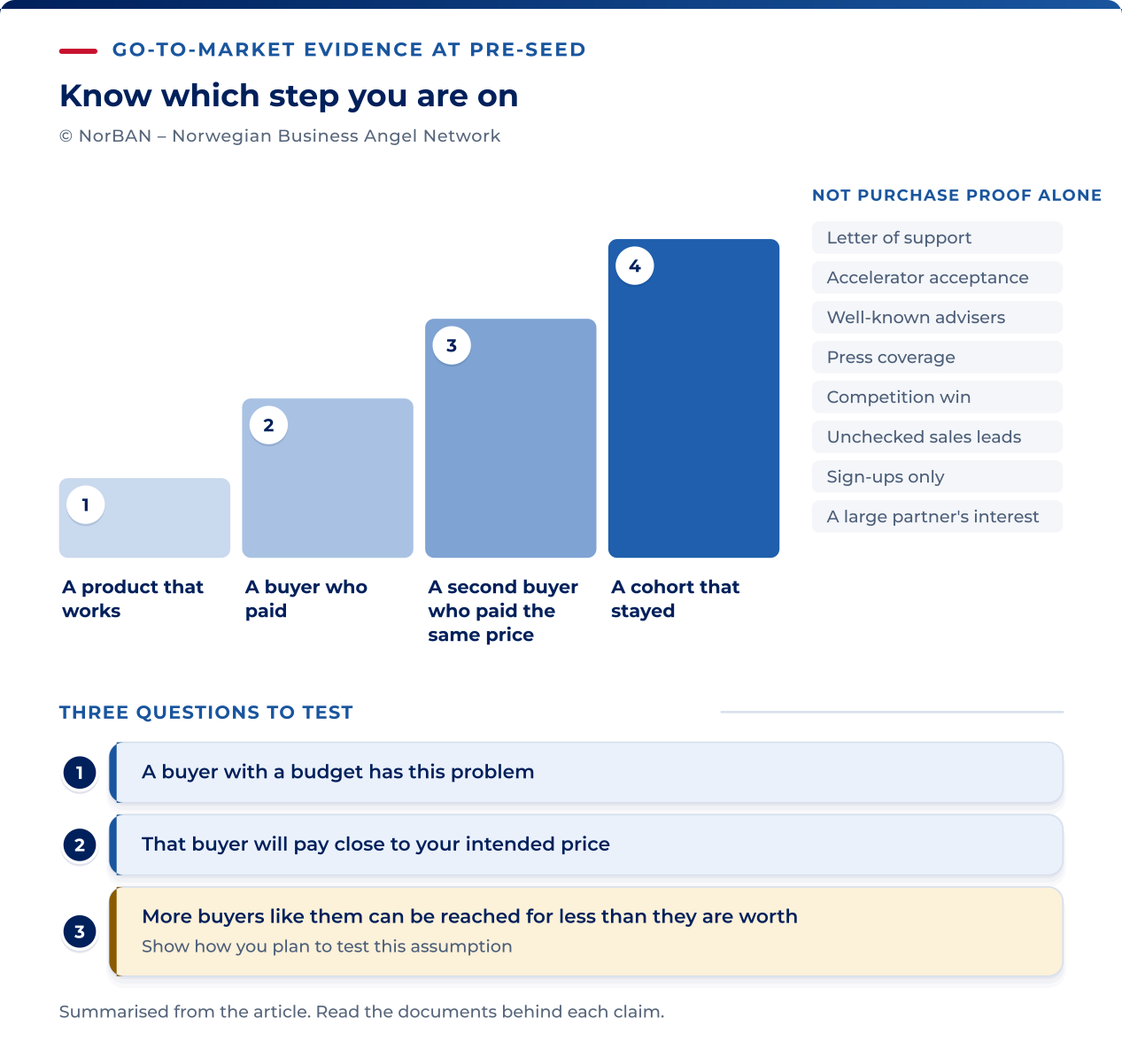
A buyer with a budget has this problem; that buyer will pay something close to the price you intend to charge; and buyers like them can be reached again at a cost below what they are worth.
Evidence about the problem or product does not necessarily explain how you will find more paying customers. Show what you know about each question and what remains untested. The balance investors require will depend on the company and its stage.
Innovasjon Norge describes investors as looking for credible plans, market response and financing that lets a company use capital effectively. A persuasive story needs evidence behind it.
One useful progression is a working product, a paying buyer, another buyer paying a comparable price, then customers who stay. Businesses may develop these forms of evidence in a different order. Use the progression to explain what you have established and what the next test will address.
What each artefact proves
Founders lose credibility when they present evidence as proving more than it does: an unpriced letter of support offered as a customer, a free pilot described as a deployment, a thousand sign-ups offered as demand. Read each artefact against the claim you are trying to settle.
| Evidence | What it can support | What remains uncertain | Useful supporting detail |
|---|---|---|---|
| Problem interviews | The problem, affected roles and current alternatives | Willingness to pay | Dated notes, the interviewee’s role and the cost of the problem |
| Letter of intent without a price | The interest or commitments actually stated | The commercial terms left open | Signatory’s authority, scope, date and which provisions are binding |
| Letter of intent with a price | Acceptance of a stated price in the described circumstances | Payment, timing and unmet conditions | Price, volume, binding status and conditions before an order |
| Design or development partner | Willingness to contribute time, resources or money | Demand beyond the partnership | Scope, assigned staff, contributions and any payments |
| Free pilot | Actual use and performance in the customer’s setting | Willingness to pay for that use | Observed use, results and agreed success criteria |
| Paid pilot | Willingness to pay the pilot price | Renewal or buying at the full ongoing price | Paid invoice, discount, scope and next purchase decision |
| Deposit or pre-order | Commitment at the stated amount and terms | Retention and product performance | Amount, number of buyers, delivery and refund terms |
| Waiting list or registrations | Expressed interest among the people reached | Purchase intent and conversion to paid use | Source, acquisition effort and what registration required |
| Continued use by a defined customer group | Ongoing value in use; paid renewals also support willingness to pay | Retention or pricing beyond the observed period | Starting group, dates, active-use definition and paid status |
| Reseller or distribution agreement | A contractual route to buyers | Actual sales through it | Responsibilities, targets and orders already placed |
| Public framework agreement | Eligibility for orders under its terms | Volume beyond any minimum commitment | Call-off procedure, minimum commitments and actual orders |
| Innovation partnership | A paid development contract | Later purchase of the resulting solution | Development phases, payments and purchase conditions |
| Grant or innovation support | Assessment against that scheme’s criteria | Customer demand beyond what was actually assessed | Award decision, criteria and conditions |
Whether a letter of intent is binding depends on its wording and circumstances, not its title. The Contracts Act is part of the legal framework. Norwegian contract law generally allows agreements without a prescribed form, but particular transactions can have formal requirements.
The usual approach is to say explicitly that the document is not binding, except for named clauses. Confidentiality, exclusivity and costs are often made expressly binding.
For public contracts, distinguish access to future orders from a contract already awarded. Under procurement regulation section 26-1, a framework agreement is limited to clearly identified contracting authorities and the suppliers that are parties, subject to permitted amendments.
A purchase under a framework agreement is a call-off. Depending on the agreement, it is awarded directly on agreed terms or through a mini-competition among relevant framework suppliers, as anskaffelser.no explains. The framework itself may also contain obligations, minimum purchases or an initial order.
Two numbers in the competition documents tell you what the place could be worth. The authority must give both the framework’s estimated total value or quantity, in the contract notice, and its maximum value or quantity, in the notice or the competition documents (veileder to the procurement regulation, point 37.5).
The estimate need not be exact, but it must be defensible when the competition is announced, and it is normally built from historical use adjusted for expected change. Read it as the authority’s own view of demand.
Once the maximum is reached, further call-offs normally cannot be made under the framework. Existing call-off contracts do not thereby disappear. Any expansion must have a lawful procurement basis and satisfy the contractual requirements; agreement between buyer and supplier alone is insufficient.
The framework and competition documents determine whether the buyer has exclusivity or a minimum purchase commitment. An estimated or maximum volume is not itself a promise to buy. Read the call-off mechanism and any minimum before forecasting revenue; a place on the framework establishes market access, not an order.
An innovation partnership includes development work paid in appropriate instalments under section 26-8. It can lead to purchase of the solution without a new competition if the agreed performance and maximum-cost conditions are met. Distinguish contracted development payments from any later purchase option; do not count the option as an order already placed.
Innovasjon Norge publishes the assessment criteria for its startup-stage instruments and records positive financing decisions in a searchable public register, so an investor can check both. The research council’s R&D tax deduction is rights-based, tested against the tax act’s definition of research and development, and carries no judgement about a market.
Designing a test that produces a document
Choose a test for the assumption your business most depends on. Aim for the smallest test that produces evidence you can show, with a name and date attached.
- A buyer with a budget has this problem. Ask what happens today, who pays and what the problem costs. Record the answers and the interviewee’s role. Written confirmation or a letter of intent can add support, but a signed document is not the only useful result.
- The buyer will pay near your price. Offer a paid pilot, deposit or pre-order on clear terms. Record the price, discounts, conditions and whether the evidence is an order or actual payment. A refusal can also teach you something.
- You can reach more such buyers. Test one channel with a defined target group. Record sources, dates, effort and outcomes, including refusals and unanswered approaches. Compare the cost with the customer value on a consistent basis.
What that looks like by company shape
Business software. A useful test is a paid pilot with agreed success criteria and a clear next purchase decision. Common Paper’s design partner agreement is a US-origin model covering early access and feedback, with choices for fees, discounts and customer references. Its standard terms assign feedback rights to the provider. Use it as an example to assess and adapt, not as the required starting point for a Norwegian contract.
A consumer product. Test paid purchases at the planned price within a defined audience; report audience size and measurement period. Before launch, a deposit or pre-order may be useful. Explain delivery and refund conditions and comply with applicable consumer withdrawal and cancellation rights. Calling a deposit non-refundable does not override those rights.
A deep-tech company still pre-product. The evidence is about the buyer rather than from the buyer: who specifies, who signs, what the qualification process is, and how long the last supplier took. Show the staff your development partner has assigned and the person responsible for the procurement route.
A regulated sale or a public-sector buyer. Identify the applicable approvals and purchasing procedure, your progress and the steps before an order or payment. Do not assume every public purchase requires the same competition procedure; value, scope and applicable exceptions matter.
What you learn about the buyer
Understanding how customers buy also provides evidence. Even before revenue, you can explain the steps a buyer must take to make a purchase.
- Who can commit the buyer. Record the person’s role and authority. The company certificate shows registered signing rights under the Register of Business Enterprises Act, but is not a complete list of authority: a managing director, job role or specific authorisation can also provide it. Check the authority for this purchase.
- Which budget pays. Is it an existing allocation, or does it need a new approval?
- Who must approve. Record the decision-makers and whom you have met.
- How long recent completed sales took. Show the period from first contact to decision and each outcome. A few cases do not establish a fixed market-wide sales cycle.
- Where each contact came from. Record the channel promptly rather than relying on later recollection.
- Why sales were lost. Use the buyer’s explanation where available; distinguish it from your interpretation.
A named pipeline with stages and dates is evidence. A pipeline value carries nothing unless the same sentence says what the number counts: how many organisations, at what stage of their own process, and what they are worth if every one of them signs at today’s price. Where you have weighted it, state the weights.
Presenting it without inflating it
Overstating evidence undermines the rest of your presentation. Apply these checks throughout the deck and data room.
- Give the counterparty, date and current status, with price where relevant. Say when a detail is unknown or not applicable.
- Arrange permission before offering a customer as a reference the investor can contact.
- For small samples, show counts first. Any percentage needs its denominator and period. See unit economics and metrics.
- Explain any probability weights used in the sales pipeline. Do not imply that unweighted potential sales are a forecast.
Where you stand in the evidence
With one paying customer, show that the purchase was a purchase: the price against your list price, who signed, what they bought, and what happens at the end of the term. Then show a second conversation at the same price.
With free pilots only, present them for what they reach: production use, named users and a success test. Say what the pilot cost the customer in staff time, name the priced test you are running next, and give the date it concludes.
Pre-product, the evidence is the buyer’s process and the partner’s commitment. Describe the qualification route end to end, say which step you have reached, and name who inside the buyer is carrying it.
The hard cases
- A pilot that ended without a purchase. Report its success criteria, results and the customer’s explanation. Explain any problems since fixed.
- A letter of intent without price as your strongest evidence. Describe its actual commitments and open terms, then explain the next test.
- A customer who cannot be named. Use a sufficiently anonymised description. Offer a confidential reference call only if the customer permits it; an investor NDA does not itself give that permission.
- A partner who contributed time but no money. Specify staff, data or test facilities provided, and what must happen before a paid purchase.
- A meeting with limited evidence. Say so, describe the next test and explain what the round would fund.
An EBAN report published in 2018 drew on 683 training participants across 41 countries in 2016–17, mostly active angels. It highlighted market evidence and the team. Treat it as a historical training sample, not a representative survey of all European investors.
Useful signals that do not establish purchases
Reputation, access and recognition can help a business. Explain that value without presenting them as customer orders. Where possible, show the concrete result that followed.
| Signal | What it does not establish alone | Stronger commercial evidence |
|---|---|---|
| Letter of support | A purchase commitment unless it actually contains one | Specific price, volume and purchasing conditions |
| Accelerator or programme admission | Customer demand | Paying customers reached through the programme |
| Well-known advisers | Work performed or sales generated | Documented contributions and introductions |
| Press coverage | Paid demand | Purchases traced to that coverage |
| Competition or award | Customer willingness to pay; judging criteria vary | Explain what was assessed and show customer evidence separately |
| Aggregate pipeline value | Likelihood or timing of sales | Organisations, stages, dates, potential values and assumptions |
| Registrations | Paying intent | Follow-up behaviour, meetings, orders or deposits |
| Interest from a large partner | A committed project or purchase | Agreed scope, responsible person, dates and commitments |
Recording it so it survives a check
During due diligence, investors may ask for the material behind a claim. Keep a single evidence register linking each claim to its documents, date, counterparty, price where relevant and a person who can verify it. Explain gaps rather than overstating what you can substantiate.
That file sits beside the data room and feeds it. Two constraints catch founders who assemble it in a hurry.
First, read the actual pilot agreement. Confidentiality may cover technical information, commercial terms and even the existence of the relationship. Check permitted disclosures, recipients and any consent requirements before sharing.
Silence about publicity does not settle whether disclosure is permitted. The Trade Secrets Act also protects information that is secret, has commercial value because it is secret, and is subject to reasonable protective measures. Unlawful disclosure can be prohibited even without a separate NDA.
Second, assess what you plan to share. A company name may raise contractual and confidentiality issues. A quotation linked to an identifiable person is personal data and needs a lawful basis under GDPR, incorporated through the Personal Data Act. Consent is one possible basis, not the only one; agree reference use in advance as a practical routine.
For logos, a practical policy is to obtain permission for the intended use. Trade Marks Act section 4 protects identical signs used for the goods or services covered, and identical or similar signs where the specified confusion test is met. Well-known marks have wider protection. It is therefore inaccurate to say that every infringement requires confusion.
Section 5 permits certain honest uses, including identifying or referring to the proprietor’s goods or services. The purpose and presentation matter. A blanket claim that all mentions need permission would be too broad; advance agreement about customer references is nevertheless a useful policy, including for data rooms.
What the next round will ask for
As the business develops, investors can expect stronger evidence on the same questions. A further useful question is whether purchases and renewals can occur without the founder personally driving every step. The relevant expectations depend on the business and round.
Record customer-group start dates, acquisition channels, completed sales-cycle lengths and reasons for lost sales as you go. Existing records may let you reconstruct some details later, but memory alone is an unreliable source.