
What monitoring is for
You cannot readily sell an unlisted holding when bad news arrives, and the other ways to respond take time. A reserve takes weeks to release, a bridge takes a month to assemble, a hire takes a quarter, and an exit conversation takes longer than any of them.
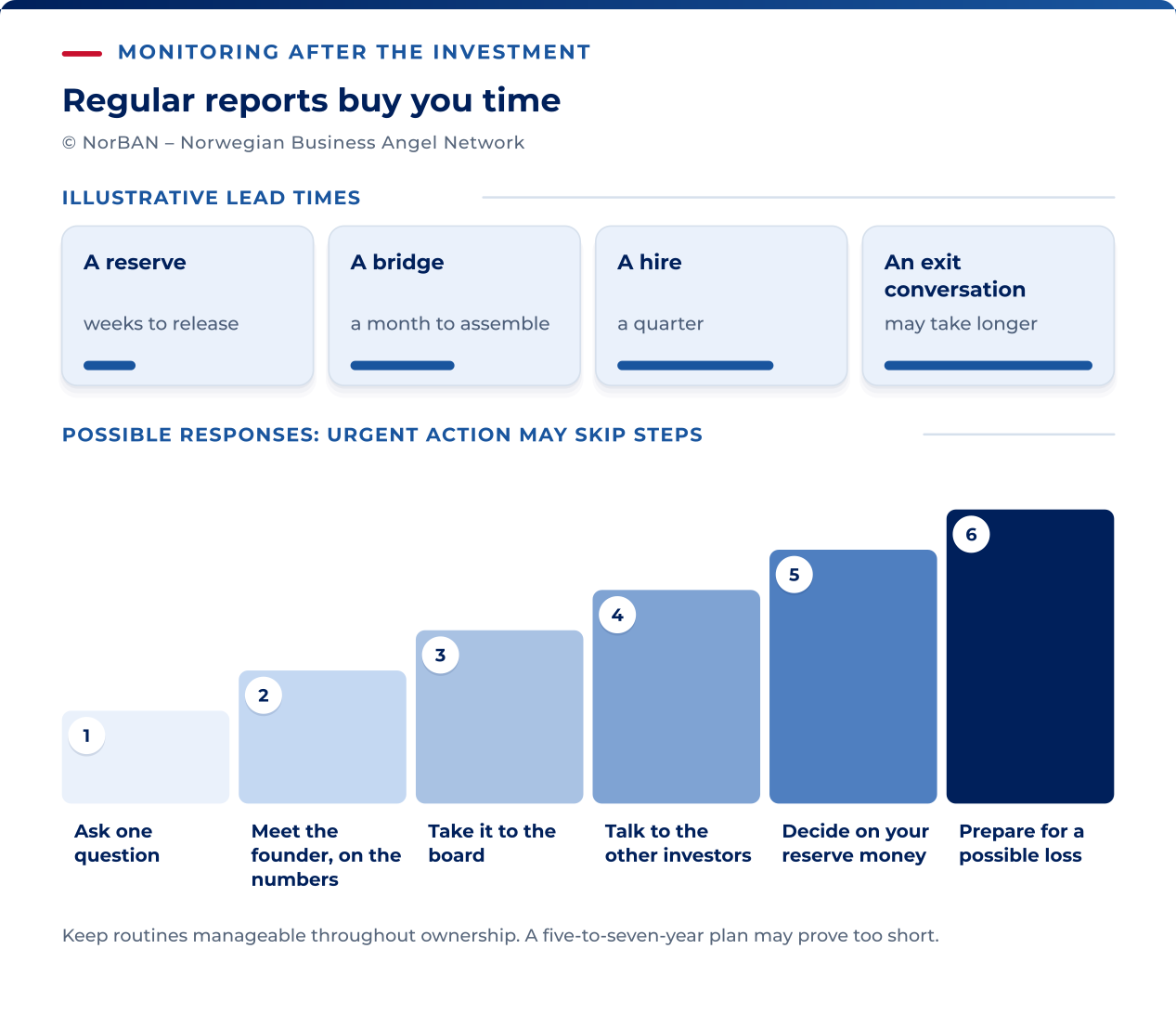
Reporting gives you time to prepare those responses. Keep the monitoring routine throughout the holding period, which may extend well beyond a five-to-seven-year planning assumption.
Keep the routine manageable enough to maintain for that long, including when there is little news.
Require the reporting at investment
Statutory rights do not provide routine management reporting between meetings. An ordinary general meeting (generalforsamling) is held within six months of the year end (aksjeloven § 5-5).
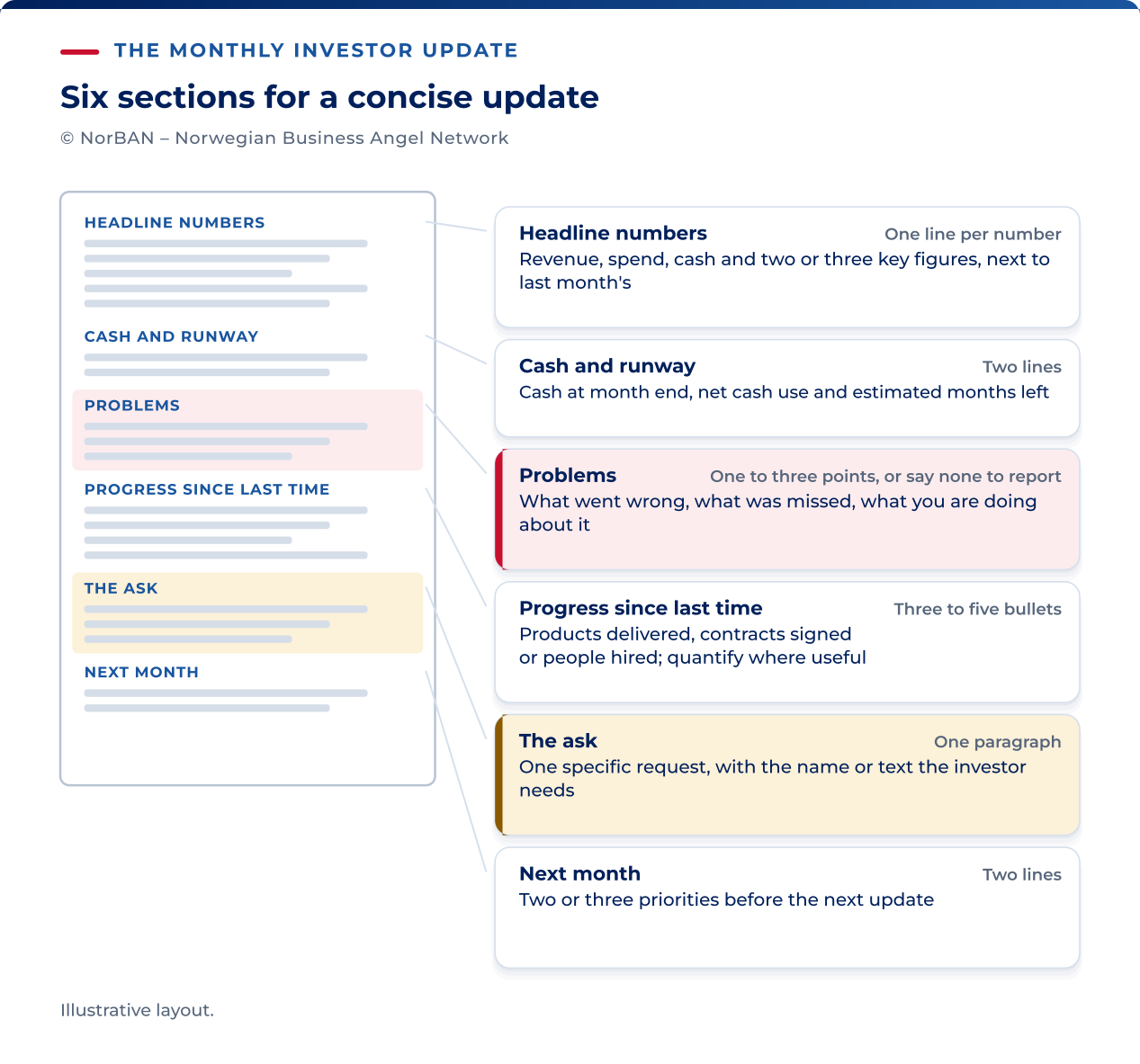
There the annual accounts (årsregnskap) are approved, and you can require information on the accounts, the agenda and the company’s position unless the answer would cause the company disproportionate harm (§ 5-15).
Anyone may inspect the share register (§ 4-6), and the filed accounts are public (regnskapsloven § 8-1). There is no statutory right to management accounts, to board papers or to a report between general meetings.
Agree routine reporting in the shareholders’ agreement (aksjonæravtale), alongside statutory information and minority rights. Information rights covering operations, financials and performance are market standard in Norwegian venture agreements, as Simonsen Vogt Wiig record, and an angel round has no reason to accept less.
Put the obligation on the company, made a party to the agreement, so the information leaves the company as a company act. The governance article covers where the right lives and how it binds. Fix these elements before the money moves.
| Element | What to fix in the agreement |
|---|---|
| Cadence | A written report at an agreed interval, dated, and a deadline for it. Agree the interval to the company’s stage and the cost of producing it |
| Contents | Cash at bank, net burn and runway; the operating metrics the investment case rests on, in the same form each time; progress against the milestones the round was raised for |
| Budget | The annual budget before the year starts, and material deviations from it when they arise |
| Accounts | The annual accounts (årsregnskap) when adopted, and management accounts on request |
| Cap table | Every change, including options granted and instruments issued |
| Access | The auditor and the books on request, and a data room kept current between rounds |
A guide published by the US Angel Capital Association in 2009 expects monthly updates plus board papers and singles out a worst-case cash report as the most important document over the life of the business.
In a 2024 global survey of angels describing their own preferences, 53 per cent named monthly contact or reports. Both are foreign practice, and what a Norwegian company can sustain is what you agree with it.
The director’s reporting line
A director nominated by an investor holds the office personally and owes duties to the company. Norwegian guidance discusses contact with those who elected the director. That is not blanket permission to pass on board papers or confidential information. Assess the information, purpose, recipients and the company’s interests before sharing.
The limit is that the board (styret) must not act so as to give some shareholders an unreasonable advantage at the expense of the others or of the company (aksjeloven § 6-28), and that a shareholder’s own information right is a metered right exercised at the general meeting (aksjeloven § 5-15). These limits require judgement in each case.
Where a syndicate needs to be kept informed, the reporting obligation is put on the company in the shareholders’ agreement, the board consents on the record, and the recipients are bound by confidentiality.
A shareholders’ agreement cannot override the director’s statutory duties. Define what the company will report, to whom and under what confidentiality terms. Whether a particular disclosure arrangement is permissible requires an assessment of the actual information and circumstances.
Directors and shareholders receive information for different purposes. A director sits on a board that must have every matter prepared so that it has a satisfactory basis for its decision (§ 6-21) and that must keep itself informed of the company’s financial position (§ 6-12); shareholder information rights are more limited and serve a different role.
Contracted reporting is how you close that gap lawfully.
For an ordinary syndicate AS, the Companies Act does not itself prescribe quarterly portfolio reports to shareholders. Agree the frequency and content in the vehicle’s own documents, alongside statutory information rights. A vehicle or manager subject to fund regulation may have additional reporting duties; assess that classification separately. The syndicate article explains the practical reporting terms.
The numbers that matter, by stage
Start each report with cash, net burn and runway, which show how much time the company has. Add a small set of operating metrics appropriate to its stage, and distinguish those from figures that look impressive without demonstrating progress.
The traction article sets out the same evidence ladder for the decision to invest; this table is that ladder read forward, quarter by quarter.
| Stage | Always | The operating set | Vanity at this stage |
|---|---|---|---|
| Pre-seed | Cash at bank, net burn, months of runway, next-round date | Problem interviews run, by role and company; paid pilots with scope and end date; conversions from pilot to contract | Survey respondents, free-tier sign-ups, waitlists without a deposit, logos “in discussion” |
| Seed | The same, plus use of proceeds against the plan | Paying customers with price and start date; gross churn by cohort; who closed each deal; pipeline with last contact and next step dated | Registered users, downloads and raw page views; cumulative charts; bookings presented as recurring revenue; net revenue retention presented as retention |
| Approaching Series A | The same, plus the milestone the next investor has named | Sales closed without the founder in the meeting; cohorts old enough to have renewed; gross margin as customers get larger; paid CAC and LTV on net profit | Growth percentages off a small base; gross merchandise value presented as revenue; total sessions driven by a few heavy users |
The vanity column follows Eric Ries’s distinction, and the TechCrunch summary of it names registered users, downloads and raw page views as the usual suspects. Josh Kopelman’s line in the same piece is the substitute to ask for in every report: “The real data is retention and repeat usage.”
The metric definitions are Andreessen Horowitz’s. Net burn, gross margin, gross churn, paid CAC and LTV computed on net profit are the five to insist on, in the same definition each quarter, because a definition that drifts turns a trend into a story.
Reading the report
First compare progress with the plan the round was raised to fund; then assess the current level. A company at 40 paying customers is doing well if the plan said 35 and badly if it said 80, and the founder’s update will lead with whichever framing helps.
- Deltas. Put this quarter beside last quarter and beside the plan, line by line. A number that moved in the wrong direction twice is a trend, whatever the commentary says.
- Cohorts. Ask for customers grouped by start month, with who is still paying and who left. A rising customer count can hide poor retention within each cohort.
- Unit economics with volume. Gross margin and paid CAC should improve as the company grows. If they do not, growth is buying revenue at a loss and the raise will fund more of the same.
- Runway against the milestone. Take the months of cash and the milestone the next round needs, and ask whether one reaches the other. If not, the company will be back for money before it has anything new to show.
A missed month is a variance, and every company has them. A model whose unit economics fail to improve with volume, or whose cohorts shrink every quarter, is a broken model, and the difference decides whether the next conversation is about execution or about the plan itself.
Early warning signs
Run these checks each quarter, against the report and against the public registers. In CB Insights’ 2026 analysis of US venture-backed shutdowns since 2023, running out of capital was the recorded cause in 70 per cent of cases.
The authors put the cause earlier, in product-market fit, timing or unit economics, and treat running out of capital as where the story ends. By the time cash is the visible problem, the cause is months old.
| Signal | What it usually means | How fast it needs an answer |
|---|---|---|
| Annual accounts (årsregnskap) filed late, or not at all | The general meeting must approve them within six months of the year end and the complete accounts must reach the register within a month of adoption, with 31 July as the backstop for a calendar-year company under regnskapsloven § 8-2. Late filing triggers a weekly penalty on a published scale under regnskapsloven § 8-3, for which board members become personally liable if the company has not paid within three weeks of the register’s demand, and continued failure ends in compulsory dissolution. A company that let that clock run has an administration problem and probably a cash one | The same week. It is checkable without asking, at the public lookup |
| Board or managing director (daglig leder) changed in the register before you were told | A departure the founder did not want to announce, or a dispute. Role changes are registered and public | The same week |
| The story changed | A new market, a new product or a new customer type between two reports, with the old one unmentioned. The first plan did not work and nobody has said so | This quarter. Ask what was learned and what it cost |
| A co-founder or key engineer left | Execution risk on the plan you funded, and often a dispute over shares still to be resolved | This quarter. Ask what the leaver holds and on what terms |
| Customer concentration rising | One customer producing most of the revenue, and the pipeline not replacing it. The company’s fate now belongs to that customer’s budget | This quarter |
| Deferred payroll, stretched suppliers or founders unpaid | Cash is already short and the report has not said so | The same week. Ask for the cash position that day |
| Targets flat three quarters running, with the commentary unchanged | The plan is a document, and the report has become a formality | This quarter. Ask what would have to change for the target to be met |
| Reports arriving late, shorter, or with the numbers moved to the end | A change in reporting that needs explanation; possible operational or financial difficulty | The same week |
What silence means
A missed report deserves follow-up, especially if it breaks an established pattern. Delays, shorter updates and figures moved behind narrative can signal problems, but do not prove concealment. Ask what caused the change, request the missing information and assess the answer against other evidence.
The cadence you agreed sets how long is too long, and one missed interval is enough. A report due at the end of the month that has not arrived by the middle of the next one is late, whatever the founder is busy with.
Ask for something specific enough to answer. Name the report, name the date it was due, and ask for cash at bank, net burn and runway by a named day. A founder who can answer that in a sentence will, and a founder who cannot has told you what you needed to know.
From signal to action
Choose a next step that matches the level of concern. Match the response to the signal, and stop at the level the signal justifies. An investor who escalates every variance to the board becomes a cost to the company.
- Ask. One question, why you are asking, by when, and what you will do with the answer. Most signals can be resolved with that answer.
- Meet. Where the answer opens more questions, a conversation with the founder, on the numbers, with the plan on the table.
- Take it to the board. Where the plan itself is in doubt, the matter belongs with the board (styret), which manages the company under aksjeloven § 6-12, and your route is your director, your observer, or a written request to the chair.
- Coordinate the co-investors. Where money will be needed, the existing holders decide together whether a bridge is available, on what terms, and who leads it. Do this before the founder has to ask.
- Decide on the reserve. Whether to release it, and against what test, is the follow-on decision, and the report you have been reading is the evidence it runs on.
- Prepare for the write-off. Where the numbers say the model is broken and no one will fund the fix, the useful contribution is an orderly end, a reference for the founder and the lessons written down for your next new investment.
The routine is the same for every position. How much of it you run yourself changes with how many you hold.
- A first position gets the full routine, in writing, from the first report, because the habit formed now is the one that survives to year seven.
- Several positions get one sheet per company with the same six lines, updated on the day each report arrives, so a missed report shows as an empty row.
- A syndicate member reads the lead’s summary and the company’s own report, because a lead who is also on the board has a duty to the company that the summary will reflect.
- A sector specialist reads the operating set as an operator would, and says so in the ask, because the founder will answer a specific question from someone who knows the business.